

Death by Literalism
The case for erotic ambiguity

August, 2024. I had attended a sex party thrown by a friend at a warehouse in Hackney. It was a public event, on the smaller side of things for these parties, probably about 150 people. Unlike a lot of other parties, this one was focused primarily on play (people rarely describe what happens at these events as ‘fucking’ or ‘sex’). There was no separate dance floor or larger social areas. In the centre of the room was an assortment of kink furniture: spanking benches, a St Andrew’s cross, a DIY glory hole cut into a bit of scenery flattage on wheels. There were mattresses too, and one of those Swinging Sixties-looking padded chaises that you could fuck on. I couldn’t even look at them without wanting to do an Austin Powers impression, so fucking on one was out of the question.
The middle of the room was where all the action was. If you wanted to chat (or rather, if you didn’t want to play), you simply stood at the edges, looking on like an unwanted debutante. This party was marketed as queer, in the way they all are, but a glance around indicated that this was of the ‘bisexual girls with fruity boyfriends’ side of things, by which I mean, it didn’t feel super queer at all.
The crowd was attractive and cool, wearing a mix of latex, harnesses and leather. People attending had a range of body types, too. Unlike, say, swingers events, which remain doggedly fixated on thin, gym-hardened bodies, queer play parties lean into body positivity. Everyone was faultlessly polite and smiled a lot. They asked for your permission before hugging you. Despite all this, shortly after arriving, I found myself pinned against a perimeter wall, feeling like matter out of place.
This wasn’t a new sensation. Lately, something had been happening every time I was in sex spaces like this one. To describe it as a crisis of desire gave it more affective heft than it elicited. Really, it was a total blankness, an absence. I let the spectacle of bodies wash over me, attempting to turn over the engine of my wanting. Nothing.
‘I just don’t find any of this horny, ‘ I complained to my friend Simon. ‘Does it turn you on?’
‘Yes’, he replied, with a certainty that made me instantly resentful
‘It’s all too OK somehow. Too straightforward. This whole wide open space. Do you know what I mean?’
‘Would kissing help?’ Simon asked.
I left soon after. On the bus home, I contemplated what, exactly, was wrong with me. I’d been on (or at least around) the London sex party world for 12+ years, and had worked in sex for most of that time. Perhaps this onset of sexual apathy was the inevitable result? But this malaise had become more intense over the last few years, in tandem with what I noticed in the culture more broadly as the margins were pulled into the centre. The kink scene had expanded to accommodate far more straight (in both senses of the word) people. Hinge was empty: The soft bois had rebranded to soft doms and migrated to Feeld. Plus, everyone (including those people who definitely shouldn’t be) was poly.
We were all so modern now. We experienced the kind of sexual freedom Philip Larkin dreamt of in High Windows:
Bonds and gestures pushed to one side
Like an outdated combine harvester,
And everyone young going down the long slide
To happiness, endlessly.
And yet. Amidst all the supposed mechanisms for connection — the conscientiousness and respect, the enthusiastic consent and the policing of sexual wellbeing — why did I feel so intensely alienated? Back then, I was convinced this was a singular experience, rather than a collective one. But now I understand perfectly what the problem is: A spectre is haunting our erotic lives — the spectre of literalism.
I think we meant well, we really did. The discursive shifts that led us here were rooted in good intentions. In the face of so much trauma and risk, of the systemic oppression of so many, ambiguity became a site of danger. Post #MeToo, when the scale of exploitation across our workplaces and institutions was laid bare, new frameworks for protection came to the fore. New laws and titles followed. Anything other than a clear, affirmative yes became a no. Men were forced to reckon with the (unintended, they’d all argue) consequences of their power. For a time, the only culturally permissible depictions of women’s sexuality — and of the sexuality of more vulnerable people — framed us exclusively as traumatised. All this sought to reduce harm by removing the shadowy spaces (and language) in which abuse had flourished. Sunlight would be the best disinfectant.
Simultaneously, we became culturally obsessed with identity. The focus on lived experience was intended to amplify the voices of the structurally excluded, but the pendulum swung too far in favour of the personal over the political. Identity began to distract from the structural, economic foundations of inequality. This suited us, as we were all increasingly fixated on ourselves and fully committed to turning our subjectivities into brands. The packaging of our selfhood on social media and dating apps continued apace. We applied the correct labels to our profiles and sorted the others according to theirs. Capitalism compelled us to become self-disciplined, self-managing, self-obsessed, autonomous subjects, and we took this very seriously.
As all these changes in how we thought about bodies and desire and self dovetailed, a new language took hold. It was one of negotiation, risk management, brand strategy, commercialised intimacy and of litigation, and it was intent on specificity. As it filtered into the darker corners of the playroom and the dungeon and the hookup app, a suspicion of slow, uncertain revelation developed. There was a need to nail down a singular meaning to all sexual experiences, and for sex and kink to exist only in plain sight.
Historically, eroticism’s charge has been found in the uncertain and the partially concealed, the interpretive and the implied. It’s why, as Roland Barthes articulates it, a woman performing a striptease is “desexualized at the very moment when she is stripped naked”. It’s the obstruction to seeing her entirely revealed which we find pleasure in, in the way that all desire is about the unattained object. In contrast to this, literalism fixates on clarity and certainty. It is the intellectual equivalent of The Big Light, whilst the symbolic requires you to descend into the basement and peer through some gloom. Under the harsh glare of literalism’s strip lighting, plurality is foreclosed and the complex interplay of meaning that happens when we desire is hollowed out.
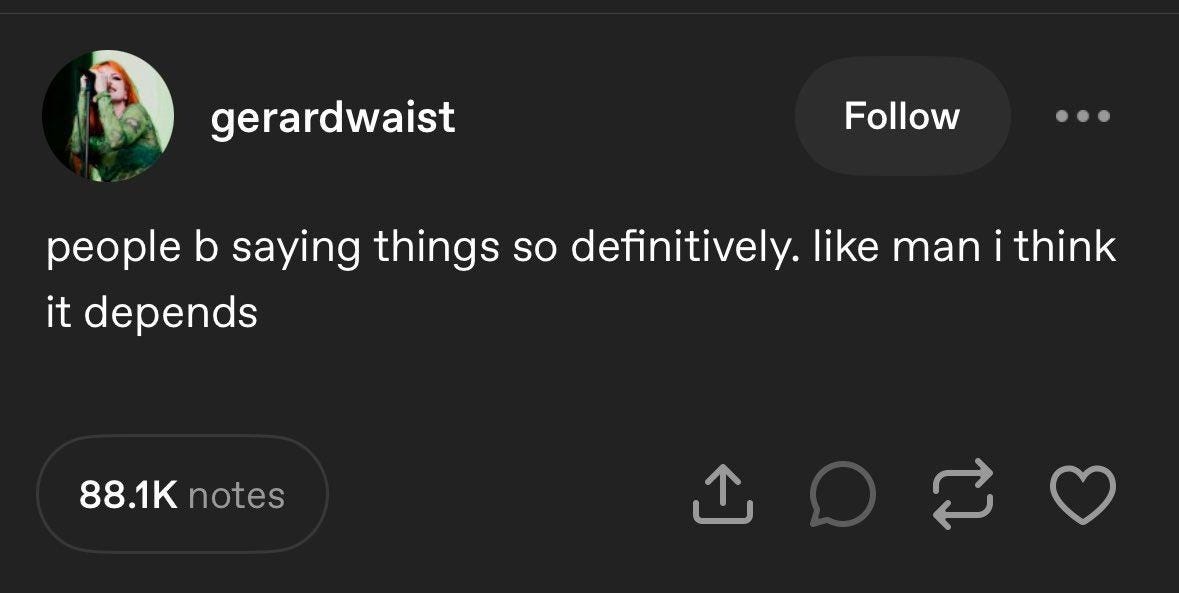
The turn towards the literal demands that we code sexuality (whether real or fictional) as definitively good or bad, right or wrong. It is presented as vital that we know exactly what we want from dating and fucking; we demand to negotiate all sexual encounters in full, in advance, so as to decide if we want them. To be a slut is fine, but only insofar as the sex you’re having is easily understood as positively good for you, and in being so, morally good. We are compelled to decide definitively if sex is empowering vs traumatic, with little regard for the vast ‘man, i think it depends’ in between.
In the search for a type of sex that felt safe and ‘fair’ (by which I mean one in which power is distributed entirely equitably, as if desire could be siphoned off from structural forces that undergird the rest of our lives), it feels as if we have forgotten that desire is a symbolic force, and that the literal is profoundly unhorny. I’d argue that all this literalism is why people (especially younger people, who grew up drenched in this stuff) have much less sex or opt for celibacy and why eroticism is increasingly frightening to so many of us — representing, as it does, something risky and unwieldy; something chaotically slippery.
Ambiguity has become too unsettling for many of us to tolerate, despite the fact that the “blindspot of understanding” as Georges Bataille described it, is integral to our experience of eroticism. If we cannot know precisely the contours of an experience in advance, we daren’t risk it, recognising desire’s capacity to undo us at the edges.
As anyone that’s worked in the sex industry will tell you, this anxiety is the elephant in the room. When booking an escort, clients are really paying to avoid uncertainty, whilst retaining some of the charge. The escort is a sure thing, but if she’s good at her job, she maintains the illusion of ambiguity within the encounter. She builds tension through frisson, the sense of ‘will they/won’t they’, even though both parties know, deep down, she will. This allows her client to enjoy an entirely de-risked experience: literalism lite
We see literalism at work in the resurgence of body count discourse, where one’s social value is flatly reducible to a number, but that number relies on a static definition of what sex ‘is’ (only a dick fucking a pussy counts in this schema). It’s there in the ways that dating and hook-up apps prompt you to spell out your sexual identity in taxonomical terms, proscribing your desires in what Foucault would call the ‘putting into discourse of sex’, In which sex is ‘incessantly solicited to reveal its truth—to speak, to display, to explain itself.’ And of course, it finds its zenith in that “orgy of realism” hardcore porn. Pornography is the cultural expression of late capitalism’s pessimistic transparency, which Mark Fisher described as trading “on a kind of earnest literalism”. Porn, he writes, is coded as “the reality of sex, and sex is the reality of everything else”. Saturated in so much of this material from such a young age, younger people’s fixation on the literal seems almost inevitable.
In Tomorrow Sex Will be Good Again, Katherine Angel wrote that good sex is apparently held hostage by the requirements of ‘consent and self knowledge” but by whose metric is the sex good? The enthusiastic consent schema that we’ve all been taught stresses the need for ongoing, affirmative checking in, before, during and after an encounter. Naturally, this requires everyone involved to know exactly what they want from the experience in advance, along with a clearly charted route from beginning to end. You have to know your likes and dislikes very clearly, as well as your hard and soft Nos.
This approach requires us to take our interlocutors extremely literally, assuming that their desire (and their speech) is completely apolitical. Yet the idea that our desire can be so honestly captured seems to miss something crucial about the individual subconscious, namely that, as philosopher Jonathan Lear puts it, “a person is, by his nature, out of touch with his own subjectivity”. Absolute personal clarity is a fiction. Just ask anyone who’s said yes to something they thought they wanted, only to realise, maybe even years after, that they didn’t.
This is not to say that you don’t need someone’s consent before you fuck them. Of course you do. But through our adherence to the belief that self knowledge is a precondition to consent— that we need to know every single thing about what we want, what might happen and how we will feel about it prior to its occurrence — we are missing something central to eroticism: that it concerns something unknowable, and therefore something risky.
This approach is dialled up to 11 within (primarily straight) BDSM settings, seemingly in direct relation to the perception of greater danger. Here, you’ll find kink as risk management, with even the faintest whiff of harm preemptively foreclosed. People routinely ask if you want to share GDocs full of predetermined likes and dislikes, or complete online quizzes to find out their kinky personality type (32% Brat Tamer!). Play parties come with comprehensive pre-attendance rules (yes, there is a test on the door), a dungeon monitor (there is another test before you enter the playroom) and a wellbeing team. If you’re thinking all this sounds a bit like, oh, I dunno, being at work, I refer you to London’s most recent kink scene addition: The co-working & dungeon hybrid. Accordingly, it becomes increasingly difficult to find real perversion in this scene. There are far fewer dark little nooks and crannies, or deep psychological depths to plumb. Everyone is deeply concerned with preventing ambiguity and with doing things right. Consent becomes more pivotal than trust. Today, the kink scene seems to me like a space of mastery - of self, of skill, of other - rather than the powerfully-charged environment in which people might experience a brief but extraordinary form of unravelling at the limits of self-understanding.1
For anyone who gets off on wrongness, it’s all just a little too safe. My fantasies all revolve around exploitation and manipulation - whether that’s coercion or cruelty or just good old-fashioned misogyny or classism. They are fantasies of entitlement, in which someone takes what they want and cares little about what they do to someone else in the process. And beyond fantasy, the encounters still scorched into my memory are full of this. Of slightly toxic but totally intoxicating fucks, where the scripts of uneven power become overwhelmingly magnified. Sometimes that’s in unknown places with unknown, unfamiliar partners. Sometimes it looks like intox, incest, non-consent, cuckolding, breeding and degradation. Other times, it’s just the feeling of being an object someone picks up and then puts down on a whim. But whatever it is, the feeling of risk and overwhelm burns brightly, and threatens to exceed the limits of ‘sex as good, clean, kinky fun’. This form of power exists precisely because it is larger than language and more complex than a simple yes-or-no. It tugs at my sense of who I am and exposes it, momentarily, as a fiction.
As the explicit and the implicit have collapsed in on each other entirely, our recognition that sex isn’t always completely ‘real’ has suffered. We are rapidly losing the ability to distinguish between the real and the representational. Within an economy of eyeballs, we demand that media’s utility be instantly decipherable, at the expense of more confusing or abstracted feelings. This leaves us paddling in the shallows of legible meaning, smoothly communicated ideas and superficial emotionality.
Younger audiences claim to see little point in sex scenes in film and TV, feeling they provide no narrative value and serve only as titillation. It’s an opinion which makes sense if one believes that sex is devoid of complex symbolic meaning. This intellectual shortfall is also being exploited in the UK’s recent incest porn ban, which criminalises adults pretending to be children, along with the fictional depiction of incest between step relations (despite the fact it is completely legal for step relations to fuck). The argument behind the ban — that depictions of incest risks normalising child sexual abuse — is essentially unprovable, and a perfect test case for anti-porn campaigners to introduce greater levels of censorship and regulation.
Let us, for the sake of argument, set aside the fact that there are actual material things the state could do to better support children in reporting CSA (and being believed when they do); or that the state and its institutions are deeply complicit with pedophilic culture, whilst continuing to scapegoat trans people, migrants and South Asian communities within a moral panic. If you take this legislation on face value, it’s clearly absurd. Anyone who has ever watched ‘step’ porn will tell you that the vast majority of it is not pitched at verisimilitude. Instead, it is an obvious pantomime of inequality, full of dialogue like “mom no we can’t I’m your step son! And dad will be home soon!”
In this, incest porn is demonstrably concerned with a hyperbolic representation of power, rather than something ‘real’. What people are searching for in ‘step’ porn is an instantly legible power dynamic, arguably the power dynamic that all of us stage and restage throughout our adult lives — parent and child. This is true of great swathes of stalwart porn settings (schools, hospitals, offices, therapists’ couches), because despite our attempts to banish them from our erotic landscapes, power dynamics remain pretty sexy. These are the spaces in which we see power differentials writ large. As porn tube sites have evolved into the fast-paced, frenzied visual economies they are today, porn producers and creators are drawing on shared cultural imaginaries that are already deeply imbued with symbolic meaning. But when we confuse the spectacular staging of power with literal abuse - when we collapse the symbolic with the real, we wilfully ignore the erotic relationship between desire, power and vulnerability.2
Because if we acknowledge that sex and sexuality aren’t literal, that they can mean many different things all at the same time to anyone involved in the encounter, we’re left with a mode of sexuality that is alarmingly unmanageable. This is a way of fucking that destabilises, rather than reinforces, categories of identity and which challenges notions of what the body is and what the body can do. It compels us to feel confused, unsettling things, and acknowledges that all that meaning could be entirely misunderstood by someone else. Literalism forces us to skate on the surface of legibility and certainty, of gesture and repetition. Without ethical and hermeneutic ambiguity, we lose a sense of fluid possibility. Only when sex retains its unknowable, uncontainable-ness, can it accommodate some of the more complex and violent aspects of the human experience, and with this, our capacity to transform them. To play with the meaning of bodies, action and power is to reflect on their instability, and therefore, the mechanics of how they’re produced.
What’s more, you do not need to know what you want to be allowed to desire. The belief that you can ever be fully knowable to yourself in this way is a convenient fantasy. To be alive is to take risks, and to take a risk is to not know. If, like me, you find your desire stalling, it may be a crisis of the literal. Seek out opacity and uncertainty. Desire prefers truth over reality.
Much of my thinking about this was informed by Avgi Saketopolou’s brilliant Sexuality Beyond Consent: Risk, Race, Traumatophilia
Love this, there's so much here I want to talk more about! 'The belief that you can ever be fully knowable to yourself in this way is a convenient fantasy' is pretty much the content of almost all my conversations in therapy and reading this is another way of helping (me) to explore how not knowing isn't something to fear, or worse, to outlaw in our ways of knowing each other.
Brava!
Without fear there is no excitement.
Unveil the mystery and the thrill is gone.
But reading about your sexuality will never get old!